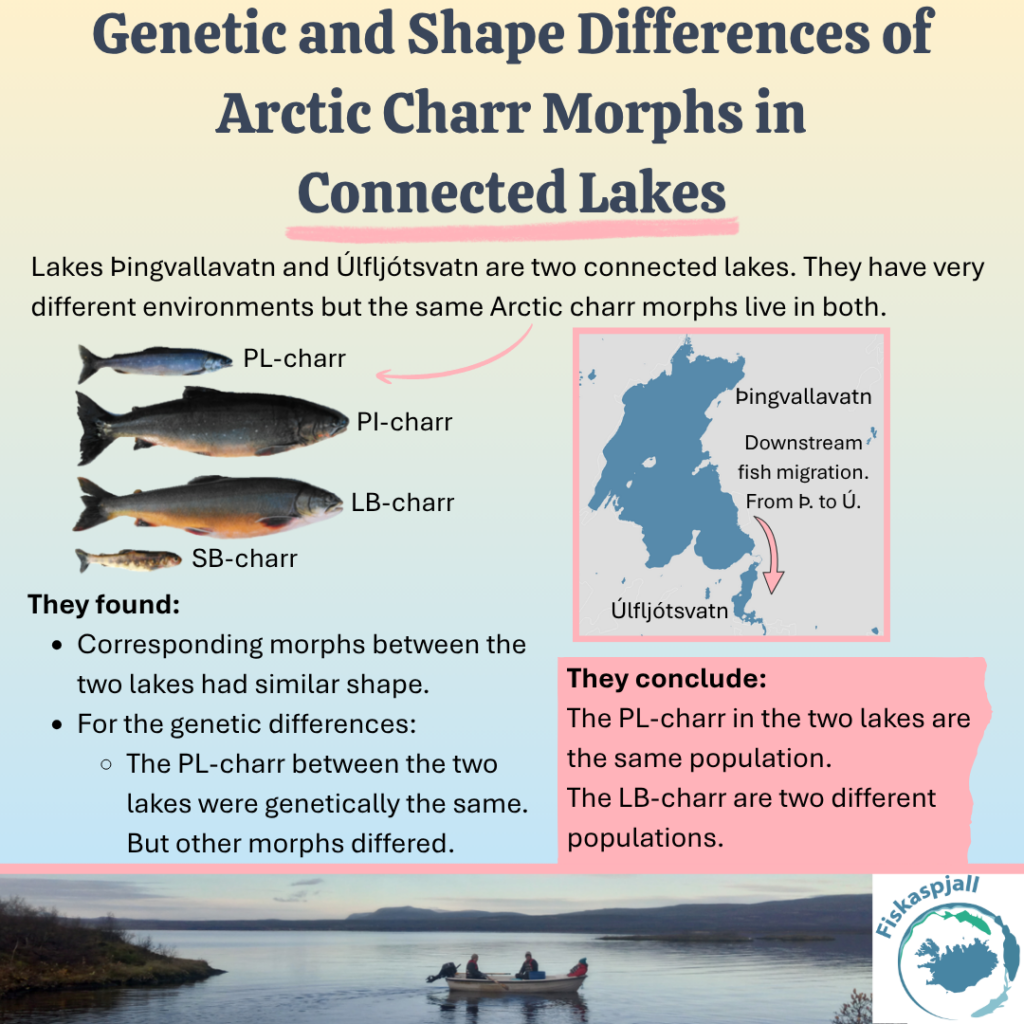
Earlier this year Han Xiao along with co-authors Arnar Pálsson, Zophonías O. Jónsson and Sigurður S. Snorrason published a paper in the journal Molecular Ecology. In this paper they explored genetic and shape differences between Arctic charr morphs in two neighbouring lakes in Iceland.
They collected different Arctic charr morphs from lake Þingvallavatn and lake Úlfljótsvatn between 2015 and 2018. Then examined the genetic differences and differences in head shape between Arctic charr morphs across these two lakes.
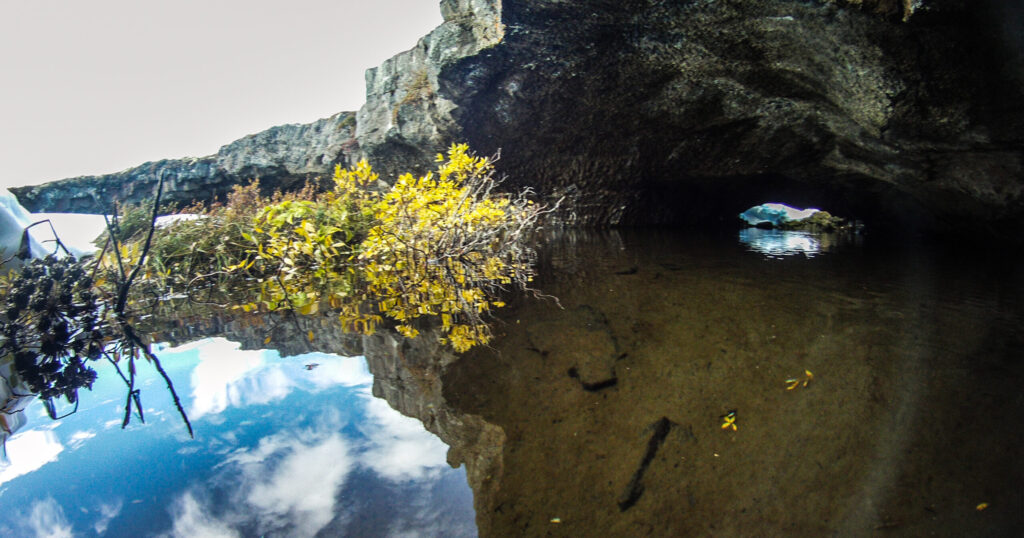
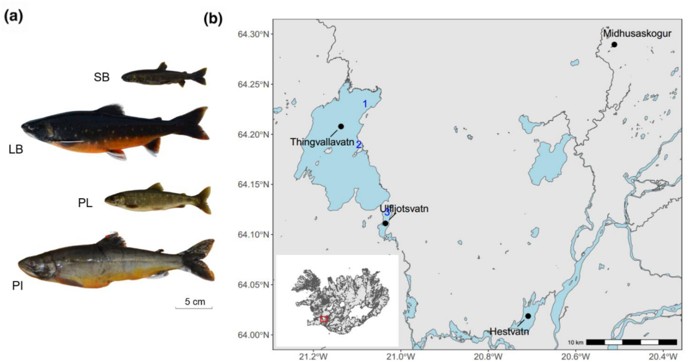
The Þingvallavatn-Úlfljótsvatn system
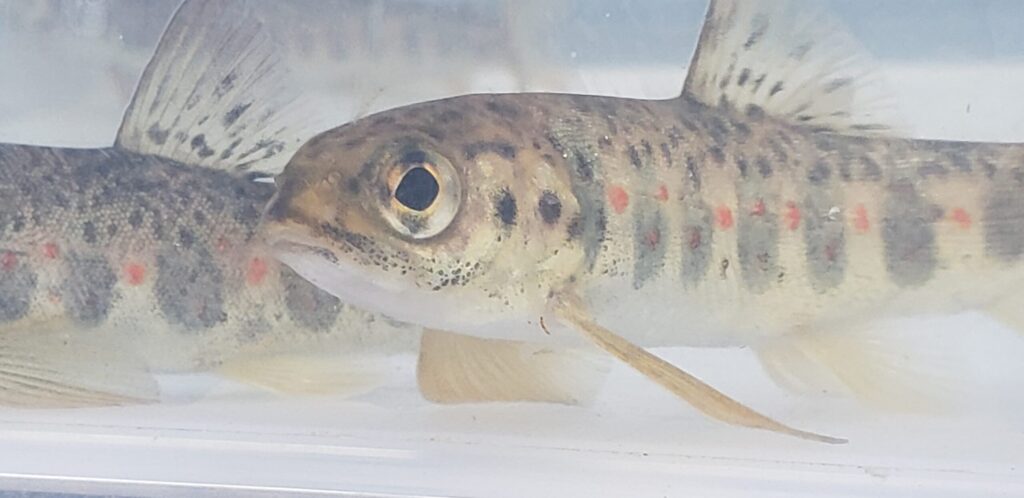
Four Arctic charr morphs live in lake Þingvallavatn. They are the large benthivorous (LB-charr), small benthivorous (SB-charr), planktivorous (PL-charr) and piscivorous charr (PI-charr). These morphs are well researched. They are known to differ in many ways for example diet, spawning time, shape and genetics. We have even discussed these morphs in previous blogposts.
Lake Þingvallavatn is not a completely isolated lake. It is connected to lake Úlfljótsvatn. Which is a smaller lake slightly south (downstream) of Þingvallavatn. All four Þingvallavatn charr morphs are also found in Úlfljótsvatn. Fish can migrate downstream from lake Þingvallavatn towards lake Úlfljótsvatn. There is a difference in abundance between the lakes. For example, PL-charr is the most abundant in Þingvallavatn but the LB-charr is most abundant in Úlfljótsvatn. Also, the SB-charr is very rare in lake Úlfljótsvatn. Likely because of low migration from lake Þingvallavatn and low survival due to as the environment is very different between the two lakes.
Lake Þingvallavatn is a larger and deeper lake compared to Lake Úlfljótsvatn. Lake Þingvallavatn is a very diverse lake with different pelagic and benthic prey for the Arctic charr to eat. However, lake Úlfljótsvatn is less diverse with mainly benthic prey available for Arctic charr. Lake Úlfljótsvatn has a very restricted pelagic zone. Which is the niche used by PL- and PI-charr. As well as a limited uneroded lava bottom. Niche used by SB-charr.
What did they look for and what did they find
Highly diverse Arctic charr morphs found across connected lakes is very rare. Therefore, this system is unique and interesting. It provides an opportunity to study how sympatric morphs can coexist across connected lakes. The researchers hypothesized that the charr morphs in the two lakes evolved once. They also think that these Arctic charr morphs could be an example of a metapopulation structure. That is a population made of many subpopulations.
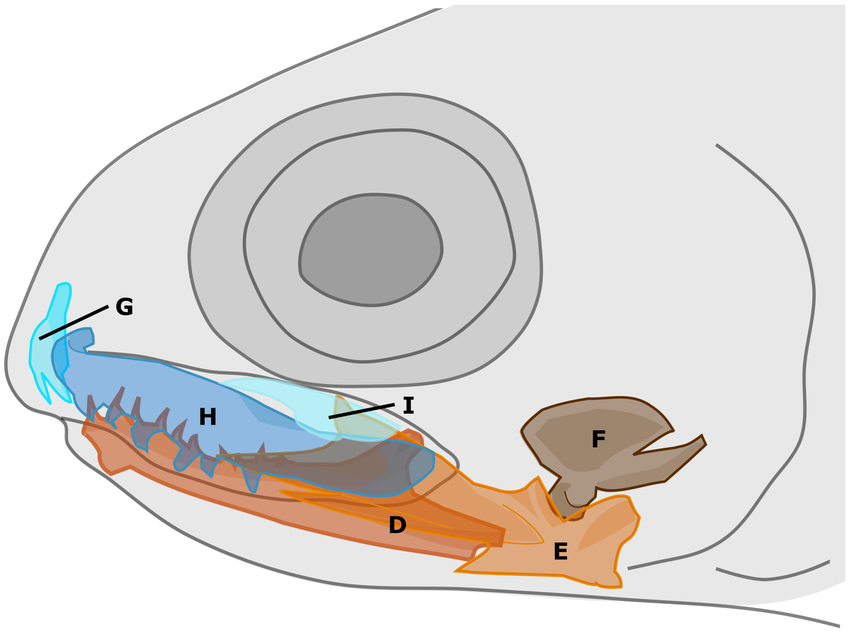
Their results showed minor variations in shape. Generally, corresponding morphs between the two lakes had similar head shape. Especially the two PL-morphs, which had almost the same shape. The genetic data gave very interesting results. The two PL-morphs from the two lakes are genetically the same. However, the two LB-morphs across the lakes are genetically different.
What do the results mean
This let the researchers to conclude that the PL-charr across the two lakes could be the same population. We can look at the two lakes as a source-sink system for this morph, where Þingvallavatn is the source and Úlfljótsvatn the sink. Because of the limited pelagic zone in Úlfljótsvatn they find it likely that the PL-charr there has low fitness. Diet data also supports this as the PL-charr prey on benthic food in Úlfljótsvatn, something they don’t do in Þingvallavatn where they have the option to feed on pelagic prey. Therefore, the researchers hypothesized that the PL-charr in Úlfljótsvatn is kept from extinction with regular migrations of PL-charr from lake Þingvallavatn.
The LB-charr is a different story, based on the genetic differences. The researchers think that the LB-charr in Úlfljótsvatn could be its own population. Which may even be spawning in lake Úlfljótsvatn. That is to say each lake has its own local LB-charr populations with its own spawning grounds. Despite being genetically different these two LB-charr populations are ecologically similar (i.e. use similar ecological niches in the two lakes).
For the PI-charr it was more difficult to understand the relationship across the lakes. The PI-charr in Þingvallavatn were shown to have mixed ancestry between PL-charr and LB-charr. Many individuals are genetically closer to PL-charr while some are closer to LB-charr. Within lake Úlfljótsvatn the PI-charr also have mixed ancestry, between the PL-charr and LB-charr from lake Úlfljótsvatn. Where a higher proportion of PI-charr cluster with LB-charr than in Þingvallavatn. This could mean that the PI-charr is hybridising with the LB-charr, i.e. PI-charr mates with an LB-charr. Hybridization between these two morphs does occur in Þingvallavatn though it appears more common in Úlfljótsvatn. Since Úlfljótsvatn is a smaller lake, it may be that the spawning grounds of these two morphs overlap more than in Þingvallavatn.
In conclusions
Taken together they found a relatively stable coexistence of the sympatric charr morphs in lake Þingvallavatn. However, in lake Úlfljótsvatn the coexistence is not stable. In that lake there is weaker reproductive isolation between morphs. Also, some morphs rely on downstream migration from lake Þingvallavatn to maintain the population. This paper truly underscores the complexity of biodiversity. Anyone interested to know more can access the article here: https://onlinelibrary.wiley.com/doi/10.1111/mec.70225