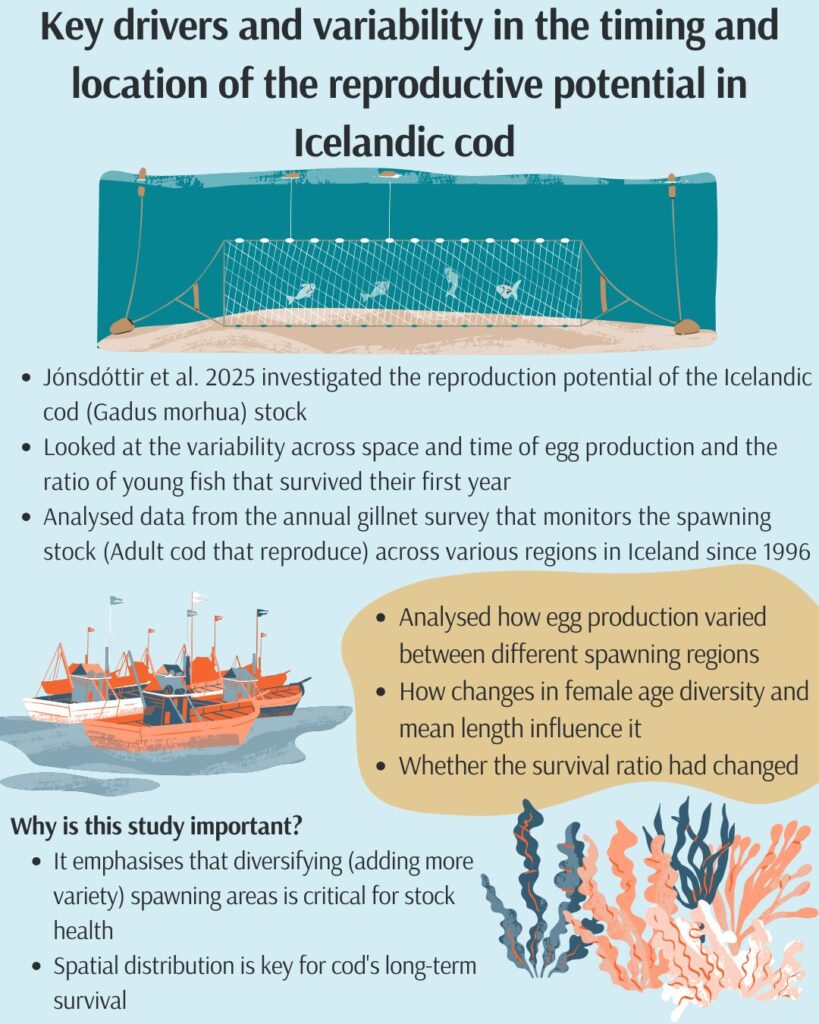
This past summer, Ingibjörg G. Jónsdóttir at the Marine and Freshwater Research Institute, along with her co-authors Jón Sólmundsson, Peter J. Wright, William Butler, and Pamela Woods, published a paper in the ICES Journal of Marine Science. The study, titled ‘Key drivers and spatio-temporal variation in the reproductive potential of Icelandic cod’, investigates the roles of total egg production and first year survival ratio (how many one year old cod out of a group survive).
To investigate this, data from an annual gillnet survey that has monitored the Icelandic spawning stock (Adult cod that reproduce) across various regions since 1996 were used to assess the reproductive potential of the stock by examining location- and time-variability in egg production and the survival ratio during the first year. Specifically, the study analysed how egg production varied between different spawning regions, how changes in female age diversity and mean length influenced it, and whether the survival ratio had changed.
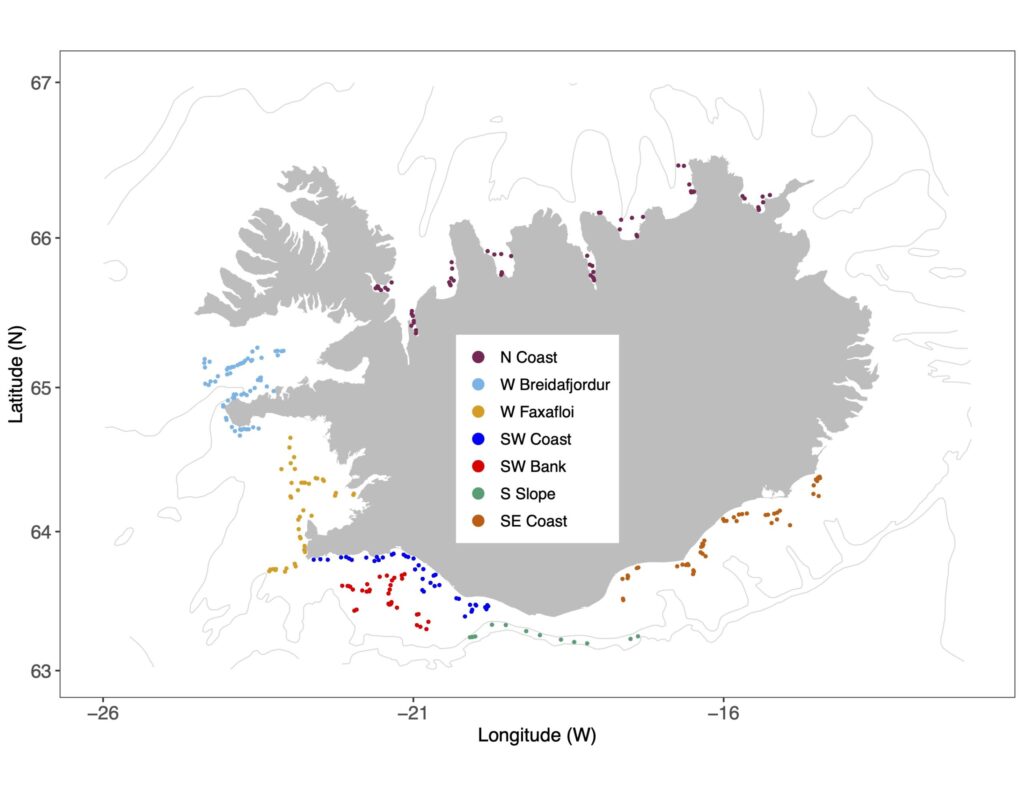
Figure represents sampling location during the annual gillnet survey. The colours define the Atlantic cod spawning regions.
What are the main findings?
The main findings show a general increase in total egg production, which mirrors the rise in spawning stock biomass. This increase in egg production was most pronounced in Breiðafjörður and Faxaflói. At the same time, a decrease was observed in the slope east of Vestmannaeyjar, where the number of spawning cod has declined substantially. However, the survival of the cod in their first year has decreased, especially since 2010. This suggests that even though more eggs are produced, a lower proportion survives. It is unclear what causes this, but it may result from increased density-dependent mortality (a higher number of deaths due to how crowded the population is). It is interesting to the public because it indicates that having more parents (a larger stock) does not automatically mean more offspring survive to adulthood.
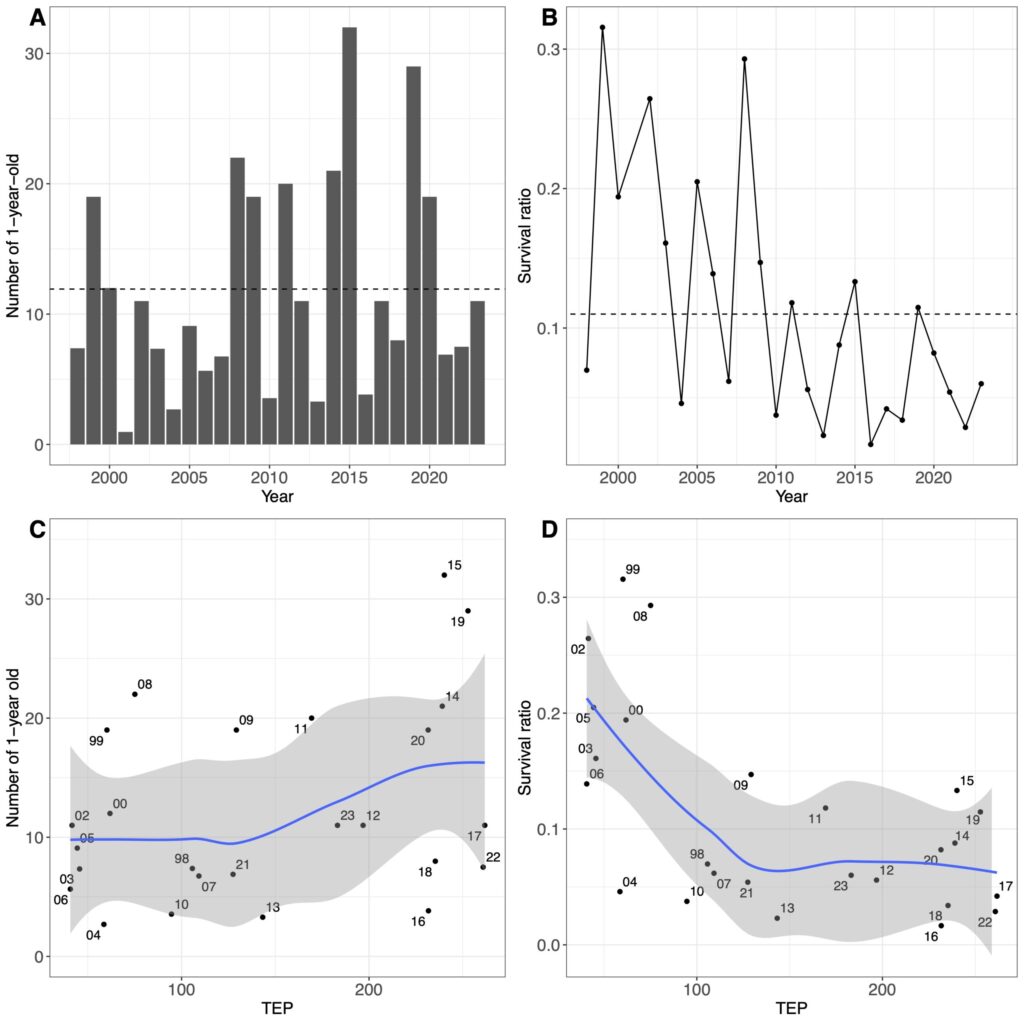
Figure represents: (A) The number of 1-year-old cod found during the yearly groundfish survey in March. (B) The survival ratio, which is the number of 1-year-old cod in March divided by TEP. (C) How TEP is related to the number of 1-year-old cod. (D) How is TEP related to the survival ratio? The horizontal lines in panels (A) and (B) show the average values. The numbers in panels (C) and (D) show the year of each group.
Who should read this research?
This research is important for a variety of audiences. Fisheries managers and policymakers can use these findings to understand the complex factors affecting cod stock. For the scientific community, the research provides valuable insight for marine biologists and ecologists interested in population dynamics and the effects of density dependence. This paper can also serve as a useful case study for students learning key concepts in fisheries science. Finally, the research is relevant to the general public, especially those interested in fishing and the marine environment.
What could future follow-up studies look like?
Future studies could investigate the specific causes of the increased mortality, such as competition for food or increased predation in areas with high densities of young cod. Researchers might also examine how ocean currents may be carrying eggs and larvae from high-production areas to less favourable environments. Additionally, more complex models could be used to predict how the stock will behave under different environmental conditions and management scenarios.
Why is it important that this research was carried out, and is there value in this research beyond academia?
This research is important because it highlights that long-term health depends on a resilient stock structure and variable spawning areas, which are crucial for ensuring successful recruitment. It provides a critical tool for sustainable fisheries management by identifying that the distribution of spawning effort across different regions and the resulting egg production are important for recruitment. This understanding helps to ensure the long-term health and productivity of the cod stock, which is vital for the Icelandic economy.
Link to paper: https://academic.oup.com/icesjms/article/82/7/fsaf128/8213717