A new publication spotlight by Nickel et al. 2025 called “Seasonal shifts and individual variation in juvenile
Atlantic cod diel migration at nearshore nurseries”. doi: 10.3354/meps15056
More publications by Nickel are found at ORCID: https://orcid.org/0009-0008-2327-5230
What is the general topic of the paper?
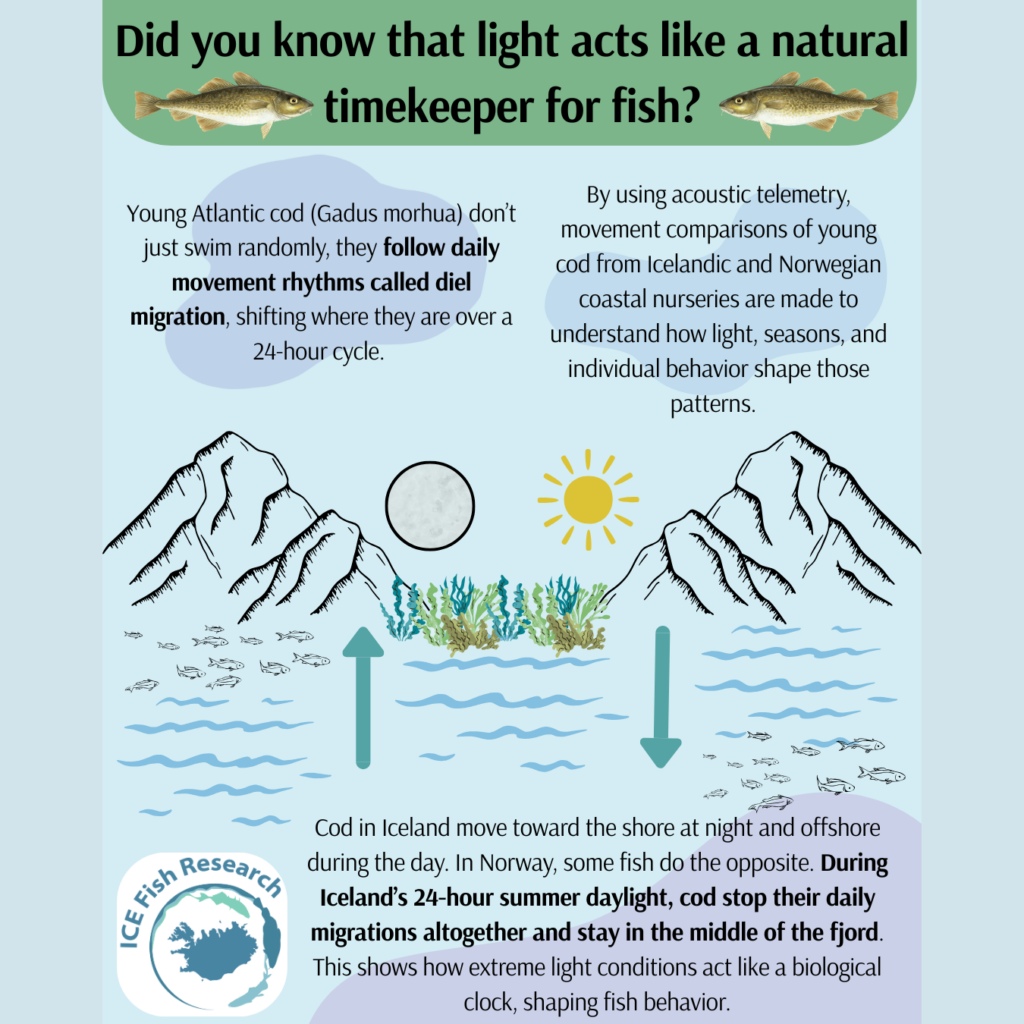
Many fish move around in regular patterns. One common type is called diel migration (dægurfar eða lóðréttar dægurgöngur), which means they move in a daily cycle over 24 hours. These movements can help fish find food, avoid predators, and grow faster. In this study, researchers looked at how young #Atlanticcod move back and forth each day in coastal nursery areas in Iceland and Norway. They focused on how their movements change with the seasons and how individual fish behave differently from one another.

Figure 1. Study site locations in Iceland and Norway (black diamonds) and acoustic receiver positions within each site (red circles). Bathymetry and land areas are shown with grey contour lines.
What are the main findings?
In Iceland, young cod followed a clear daily pattern: they moved closer to shore at night and farther offshore during the day. In Norway, some fish followed this same pattern, but others did the opposite.
The timing of these movements matched changes in daylight, especially at sunrise and sunset. During the Icelandic summer, when the sun barely sets, the fish stopped their usual daily movements and stayed in the middle of the fjord instead. Even though most fish followed similar seasonal patterns, individuals still differed in how often they moved and in the direction they moved. This tells us that both the environment and each fish’s own traits shape their behavior.

Figure 2 and 3. Predicted mean distance to land (DTL) across the day (hourly) and site (A = Iceland, B = Norway), based on results from a generalized additive mixed model (GAMM). White lines indicate the mean times of sunrise and sunset for each detection week and site.
The most exciting result is that nonstop summer daylight in Iceland stops the fish from doing their usual daily migration. This shows how extreme light conditions in the Arctic act like a natural clock, guiding animal behavior in surprising ways.
What methods were used?
The researchers used a tracking method called acoustic telemetry. Small transmitters were placed inside young cod. These transmitters sent signals that were picked up by underwater receivers placed across a fjord in Iceland. Every time a fish passed a receiver, its location and time were recorded. This gave a detailed picture of where each fish went throughout the day and across seasons.

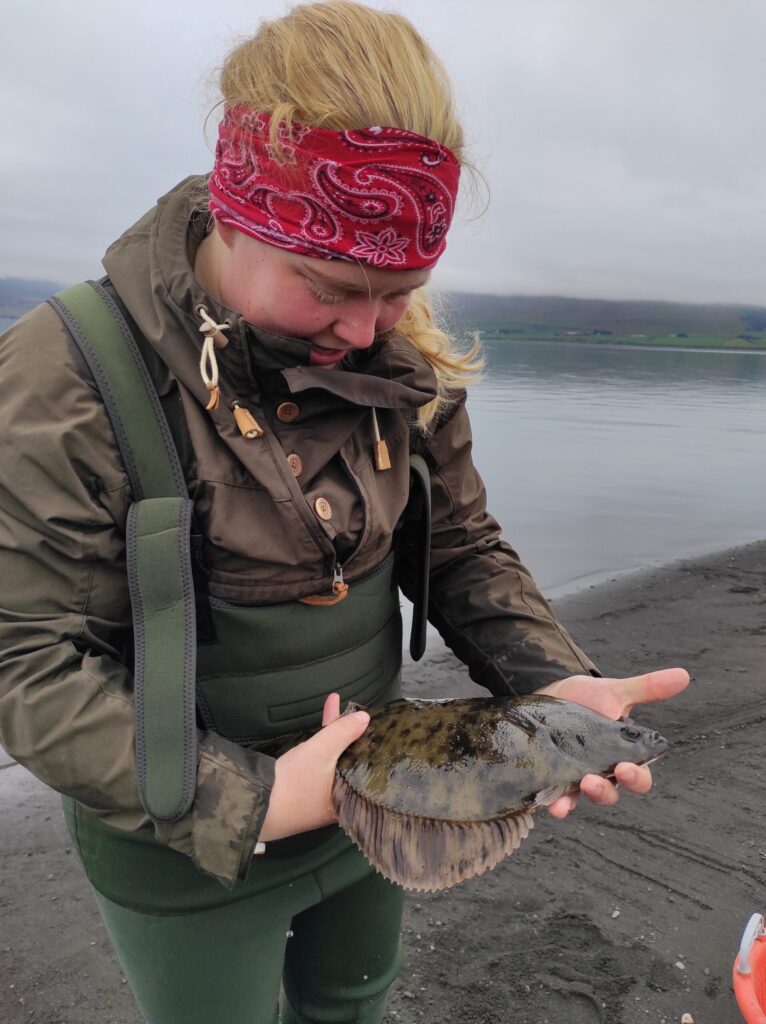
Figure 4. Releasing young Atlantic cod back into the wild after giving them acoustic transmitters.

Figure 5. Infographic on what acoustic telemetry is and what it does.
Who should read this research?
This study is great for people interested in fish behavior and ocean ecology. It’s also useful for fisheries managers in Iceland and Norway, since cod are extremely important to their economies and ecosystems. Additionally, researchers studying Arctic and sub-Arctic environments, animal behavior, and biological rhythms may also find these results helpful.
What could future follow-up studies look like?
It is now known that light plays a big role in guiding daily fish movements—but there’s still more to learn. Future studies could look at:
- How predators affect when and where fish move
- How temperature and water depth influence behavior
- Where and when fish feed
- How these movements affect growth
Studying different sizes and ages of cod would give an even clearer picture of what shapes these daily migrations.
Why is this research important beyond academia?
Understanding how young cod move and respond to light helps explain how they grow and survive. This knowledge can help improve fisheries management and conservation. As climate change shifts habitats and light patterns in northern oceans, this research can help predict how fish behavior might change in the future.
co-authors and collaborators to highlight
This project took years of hard physical and mental work. It involved hauling heavy equipment, long days on boats, and many hours analyzing data. The co-authors and collaborators of this study are thanked for their energy and dedication—especially Michelle Valliant, Ragnar Edvardsson, Halldór Sveinbjörnsson, Antoine Morel, and Even Moland. This research truly was a team effort.