What do a hippo and a fish have in common? They come in small sizes! Miniaturisation is when animals evolve to be smaller over time. This often happens on islands or in places where populations are cut off from others. Scientists still don’t fully understand why this happens.
Dr. Kalina Kapralova and other researchers from the University of Iceland (LUVS and Keldur), Hólar University, and the University of St. Andrews are working together on this project. They are using the Icelandic Arctic charr to answer their research questions.
Dwarf Arctic charr as a study system
The dwarf Arctic charr (shown below in the video) offers the chance to study evolution in action. This fish has evolved tiny forms repeatedly over a relatively short time and in closely related populations. The researchers will try to figure out how and why this happens. This will help reveal the processes that generate and maintain biodiversity. This information provides insight into how species may adapt to rapidly changing environments such as those shaped by climate change.
A small benthic Arctic charr swimming.
Why do some Icelandic Arctic charr stay small?
To understand why some Icelandic Arctic charr grow little, mature early, and look juvenile for their entire lives, Kalina and her team are looking both at wild populations and laboratory dwarf charr families. In the lab they can track traits from parents to their offspring. In wild fish, natural mixing of genes over thousands of years helps find DNA regions connected to body size.
Stripes carry a surprising amount of information
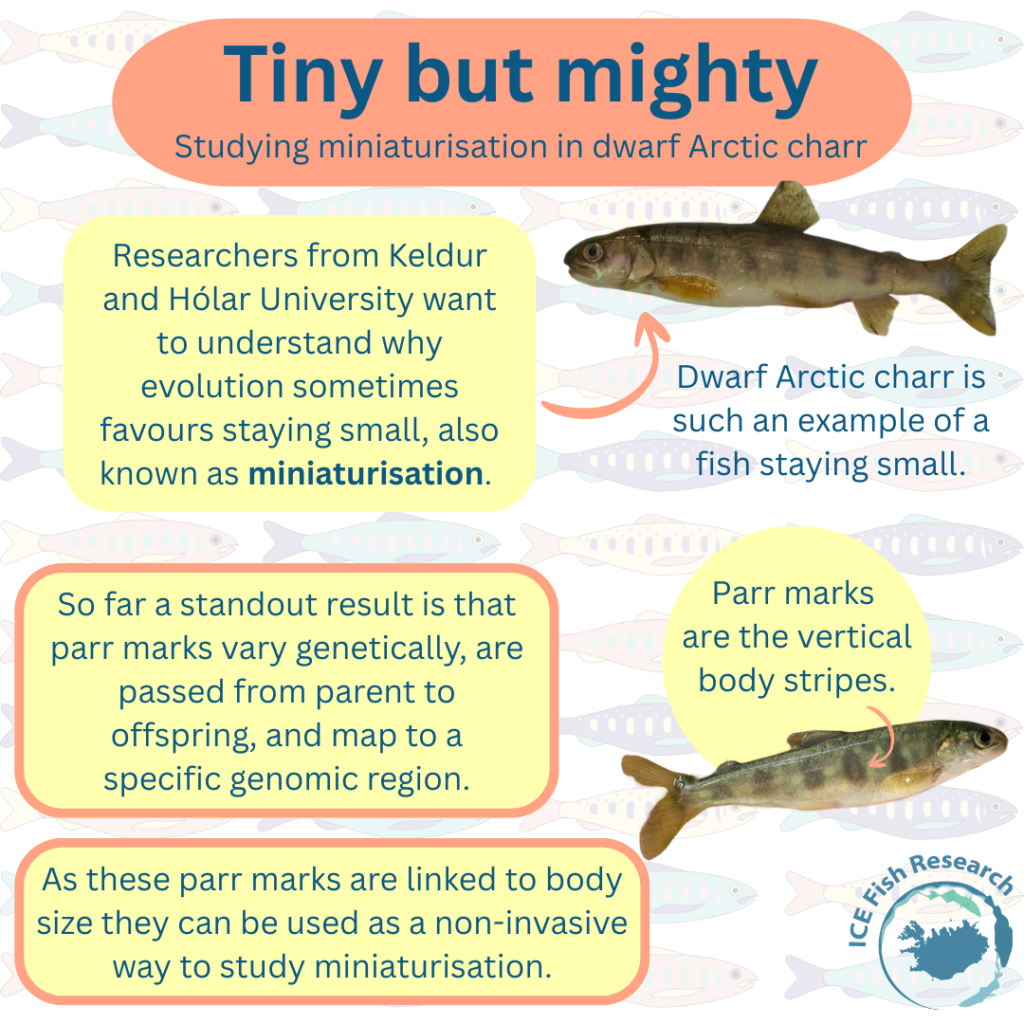
Parr marks are vertical stripes found on the body of juvenile salmonids and dwarf Arctic charr often keep these parr marks into adulthood. Kalina and her team found that these parr marks vary genetically and are passed from parents to offspring. Furthermore, they found a weak but consistent link between parr marks and body size making parr marks a non-invasive way to study miniaturisation.
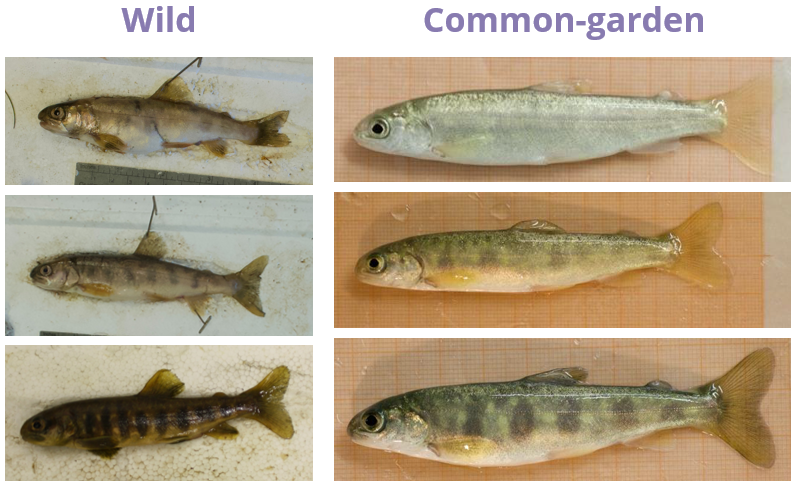
Parr marks in wild and laboratory-reared small benthic Arctic charr.